Formulating research questions, conducting literature reviews, comparing datasets, creating charts and presentations, or writing academic papers. These are typical everyday tasks for students, lecturers and researchers. In autumn 2022, ChatGPT – one of the first artificial intelligence (AI) systems for the general public – was launched; a disruption that has not only massively accelerated the development of further AI assistants, but has also set in motion profound societal changes, the full extent of which is still difficult to grasp today.
In just a short period of time, OpenAI’s generative artificial intelligence has become one of the most popular tools for handling tasks such as those mentioned at the start, all at the touch of a button. AI tools have become part of people’s everyday lives worldwide, not least thanks to OpenAI’s groundbreaking and, above all, easily accessible technology.
In this blog post, we take a look at the opportunities, challenges and changes that artificial intelligence brings for universities and higher education institutions. How does the existence of artificial intelligence affect teaching, learning and research? What strategies have higher education institutions developed not just to ‘come to terms with’ the impact of AI, but to actively build on it? And are tools like “ChatGPT” all that AI has to offer – or is there a much broader field of research behind it?
From the concept of the ‘thinking machine’ to an everyday companion
In its new AI Act, the European Parliament defines artificial intelligence as “AI is the ability of a machine to display human-like capabilities such as reasoning, learning, planning and creativity. AI enables technical systems to perceive their environment, deal with what they perceive, solve problems and act to achieve a specific goal. The computer receives data – already prepared or gathered through its own sensors such as a camera - processes it and responds.”
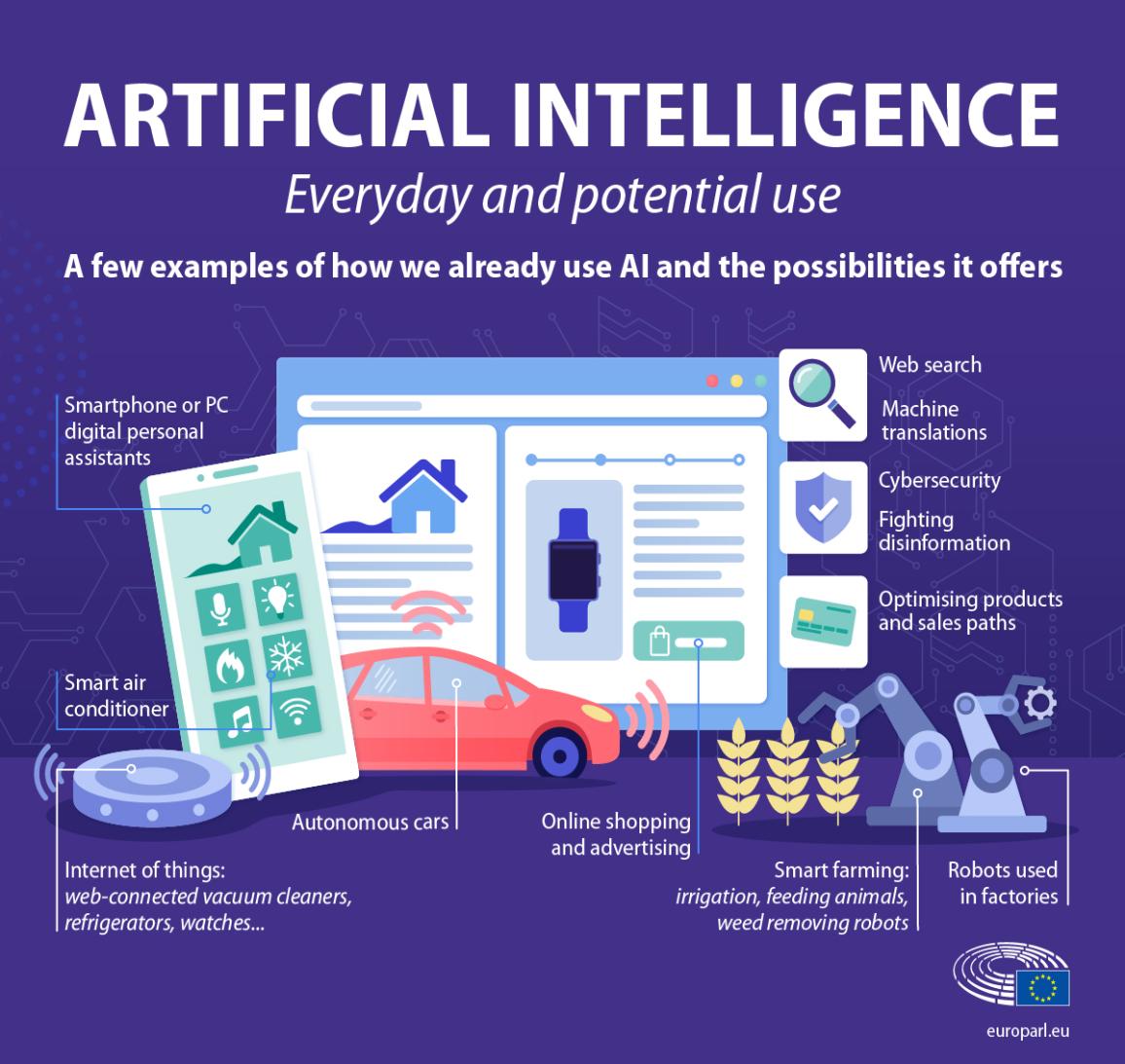 Artificial intelligence is already ubiquitous in many areas of everyday life. - Photo: European Parliament
Artificial intelligence is by no means a new invention: the dream of creating a “thinking machine” has been around for as long as humanity has existed. Over the past century, many developments took place simultaneously: the first attempts to develop neural networks and algorithms were successfully implemented. At the same time, people sought to approach the subject of artificial intelligence through thought experiments or philosophical approaches – such as Alan Turing’s Turing test. On a fictional level, too, attempts were made to explore the (future) possibilities of AI, resulting in numerous books and films on the subject. IBM provides a historical overview of the emergence of AI.
Universities, too, have been studying the fundamentals of artificial intelligence since the middle of the last century. Initially, the field of research was theoretical in nature and primarily rooted in computer science. Later, AI became increasingly interdisciplinary and found its way into fields such as medicine and engineering. Thanks to more advanced computing power and new algorithms, major breakthroughs in AI have been achieved in recent years. Breakthroughs that are driving the digital transformation of society forward. Breakthroughs that, at the same time, mean profound changes in all areas of everyday life – both positive and negative.
AI as a disruptive force: Fundamental Changes in the Higher Education Sector
The disruption caused by artificial intelligence in many areas of social life is also having a direct impact on university and higher education. This has given rise to new challenges and opportunities. Everyday tasks carried out by students, lecturers and researchers – such as those mentioned at the outset, including formulating research questions, conducting literature reviews, comparing data sets, creating diagrams and presentations, and writing academic papers – as well as administrative tasks can be supported by artificial intelligence. It is important to define the basic rules for the use of AI in order to ensure transparent and fair working practices for everyone.
 The use of AI in everyday university life raises many questions. - Photo: Nahrizul Kadri, Unsplash
Increased student engagement thanks to AI: Potential for Studo
Studo has always focused on simplifying and digitising administrative and academic processes. Artificial intelligence offers great potential here to further optimise solutions for students and university staff, or to implement new innovations.
Student engagement, for example, is a highly topical issue that numerous universities – and Studo – are addressing. Supported by Studo’s personalised AI, academic engagement could be boosted by suggesting a tailor-made timetable to students – based on their availability, interests and goals. Following the same approach, students could also be offered targeted exam suggestions, making exam registration even more accessible and encouraging them to sit exams.
Although these and many other ideas are still in their early stages, they could lead to significant improvements in student engagement for universities and students alike. With a decade of experience in software development for higher education and a large user community, Studo is currently exploring new ways to harness the potential of artificial intelligence within its own services.